
Sensory Lab · Coffee Science
Roasted On, Not Best By
Somewhere on a supermarket shelf sits a bag of coffee with a date stamped near the seal: "Best By — March 2027." It sounds precise. It sounds like it means something. It doesn’t mean what most people assume it means, and coffee is one of the clearest places to see why.
What "Best By" Actually Regulates
In the United States, "Best By" — or its officially preferred phrasing, "Best if Used By" — is not a food safety requirement. With the sole exception of infant formula, the FDA and USDA do not require date labels on packaged food at all. The phrase exists because both agencies, after years of consumer confusion contributing to an estimated 20 percent of household food waste, began encouraging manufacturers to standardize around one voluntary term meant to signal quality, not spoilage. Federal regulation does not prohibit a company from printing a different phrase entirely — "Sell By," "Use By," whatever a given brand’s legal team prefers — as long as it isn’t misleading.
A "Best By" date on a bag of coffee, in other words, tells you almost nothing about when that coffee was actually roasted. It tells you when a company’s internal shelf-life policy — often set to maximize distribution windows rather than flavor — runs out. A bag can carry a date eighteen months out and have been roasted the same week it was packaged, or it can carry that same date having already spent four months in a warehouse first. The label doesn’t distinguish between the two, because it was never designed to.
What Actually Happens After Roasting
Coffee has a real freshness window, and it’s short — measured in days and weeks, not months.
The moment beans come out of the roaster, they begin releasing carbon dioxide — a byproduct of the chemical reactions that occurred during roasting — in a process called degassing. That CO2 does something useful at first: it acts as a barrier, slowing oxygen from reaching the bean’s interior. Within days, most of that protective gas has escaped. Once it does, oxygen moves in more freely, and staling — the oxidation of aromatic compounds and the lipids that carry much of a coffee’s flavor — accelerates. Researchers studying this mechanism as early as the 1990s identified two primary causes: the release of volatile aroma compounds alongside CO2, and the oxidation of what remains once that protective barrier is gone.
Professor Chahan Yeretzian, who heads the Coffee Excellence Center at Zurich University of Applied Sciences, has measured aroma loss beginning within a single day of roasting — though the full picture is more complicated than "fresher is always better." In the first few days after roasting, residual CO2 is high enough that it can interfere with brewing, making extraction less even and harder to control. Most coffee professionals put the peak flavor window at roughly four to fourteen days post-roast: early enough that the aromatics haven’t faded, late enough that the CO2 has settled to a manageable level.
From there, the decline is steady rather than sudden. Research modeling the secondary shelf life of ground roasted coffee, published in the Journal of Agricultural and Food Chemistry, has shown that measurable aroma markers can fall to a fraction of their original intensity within about two months, even under reasonable storage conditions. None of this is marketing language. It’s food chemistry, published in peer-reviewed journals, documented since at least the early 1990s.
What "Best By" Answers, and What It Doesn’t
None of this means "Best By" dates are dishonest. It means they answer a different question than the one worth asking. The useful question isn’t "how long until this is unsafe" — coffee doesn’t spoil the way perishable food does — but "how long ago was this actually roasted."
That’s a date most large commercial roasters don’t print, in part because their supply chains often can’t answer it precisely: beans may sit for weeks between roasting and retail placement, moving through distributors before reaching a shelf. It’s a date small, specialty-focused roasters print because they can, and because the honest answer tends to be measured in days, not months.
A bag stamped "Roasted On" instead of "Best By" is not a marketing flourish. It’s a shift in what’s being disclosed — from a shelf-life estimate calculated by a distribution department, to the one fact a drinker actually needs in order to judge freshness for themselves.
An Honest Caveat About "Roasted On"
A roast date is a disclosure, not a promise that the bag in hand left the roaster last week. Small-batch roasting turns over slower than a commodity supply chain restocking a supermarket shelf, and a bag can sit correctly sealed for a few extra weeks before it reaches a specific customer. That’s a real tradeoff of small-batch production, not a hidden one.
It’s also not as simple as "earlier is always better." Coffee professionals judging competitions don’t cup a coffee the day it comes out of the roaster — the accepted practice is to let it rest first, giving residual CO2 time to release and the flavor compounds time to settle, typically somewhere in that four-to-fourteen-day window covered above. A bag roasted last night is not automatically the best version of itself; it’s still degassing. What actually matters is staying inside the window where the aromatics haven’t faded and the gas has had time to calm down — not chasing the shortest possible gap between roaster and doorstep.
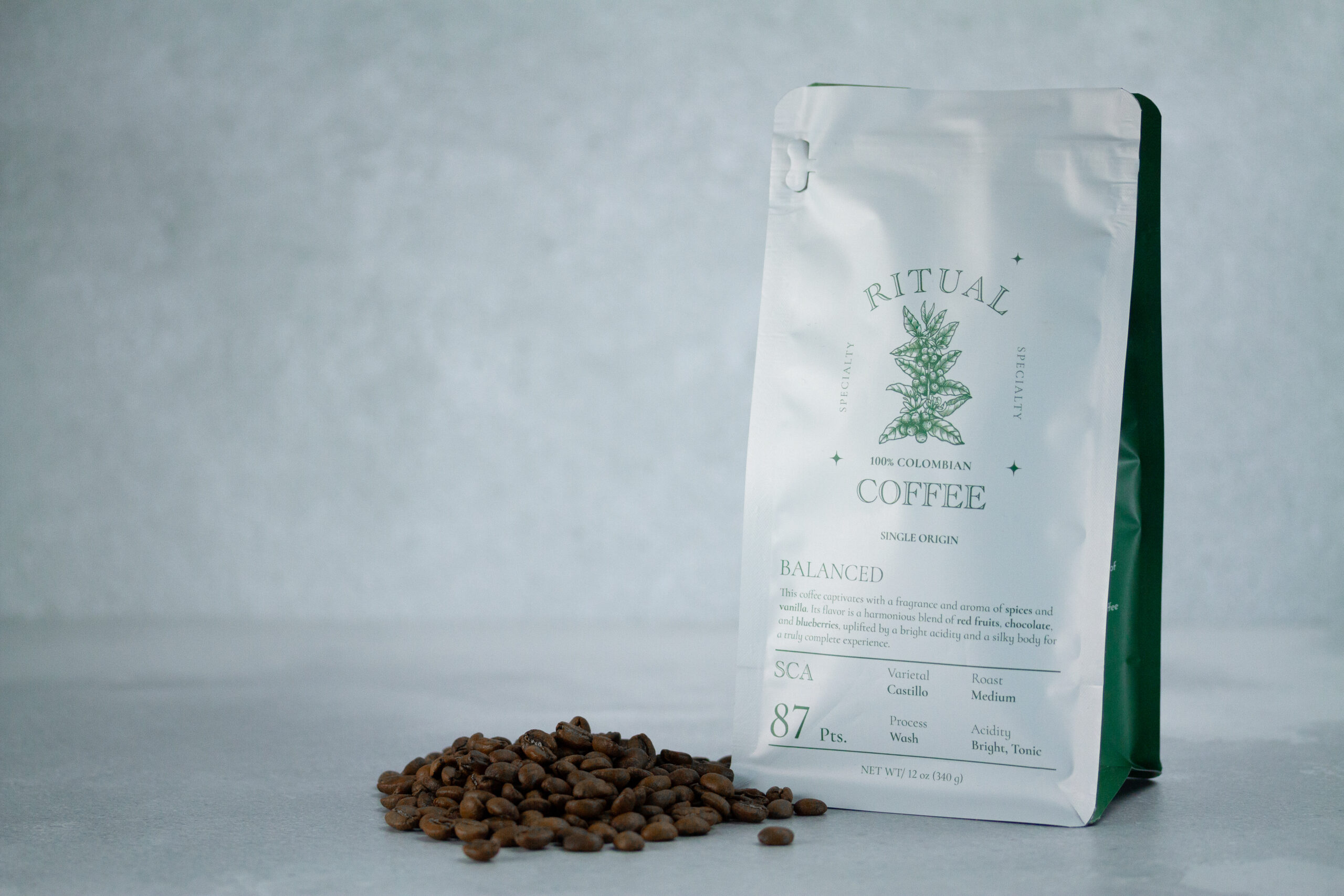
This is exactly why the packaging matters as much as the date does. Ritual’s valve and bag specification is built to hold a coffee inside that window for longer than commodity packaging would, tested specifically for that purpose rather than assumed to work. The date tells the truth about when the coffee was roasted. The packaging is what keeps that truth from being a liability even when a few extra weeks pass before a bag reaches a cup.
Three Things Worth Checking
Before the next purchase, three checks take less time than reading the rest of the label. First, whether the bag carries an actual roast date at all, rather than only a "Best By" date calculated somewhere upstream. Second, roughly how recent that roast date is — earlier is generally better, though a well-sealed bag with an intact valve holds up longer than most people expect. Third, whether the bag has a one-way valve, which lets accumulating CO2 escape without letting oxygen back in — a small piece of packaging engineering that matters more than most labels suggest, and one that darker roasts in particular depend on, since a faster, more aggressive roast profile tends to generate CO2 more quickly than a slower one.
None of this is a test to pass. It’s information a buyer is entitled to, presented plainly enough to use.
Sources
FDA, "How to Cut Food Waste and Maintain Food Safety," accessed 2026. fda.gov
USDA FSIS, "USDA Revises Guidance on Date Labeling to Reduce Food Waste," December 14, 2016. fsis.usda.gov
Specialty Coffee Association, "What Is the Shelf Life of Roasted Coffee? A Literature Review on Coffee Staling," sca.coffee
Nicoli, M.C. and Savonitti, O., cited in USPTO patent literature (US10390546, US11375731), referencing Illy, E. and Viani, R., "Espresso Coffee: The Science of Quality," Elsevier Academic Press, 2011.
Anese, M., Manzocco, L., and Nicoli, M.C., "Modeling the Secondary Shelf Life of Ground Roasted Coffee," Journal of Agricultural and Food Chemistry, 54(15), 2006.
Chahan Yeretzian, Coffee Excellence Center, Zurich University of Applied Sciences, cited in Clive Coffee, "Is Your Coffee Too Fresh?," May 2026.
You deserve a better coffee.
Shop the coffeesTaste what a verified score means
100% Colombian single origin. Cupping Score 84 to 87, scored by certified Q Graders. Roast date on every bag.
Shop on Amazon